From Mill Town to Mountain Town: How Bend Became One of the West’s Most Desirable Places to Live
October 28, 2026 · Angie Cox
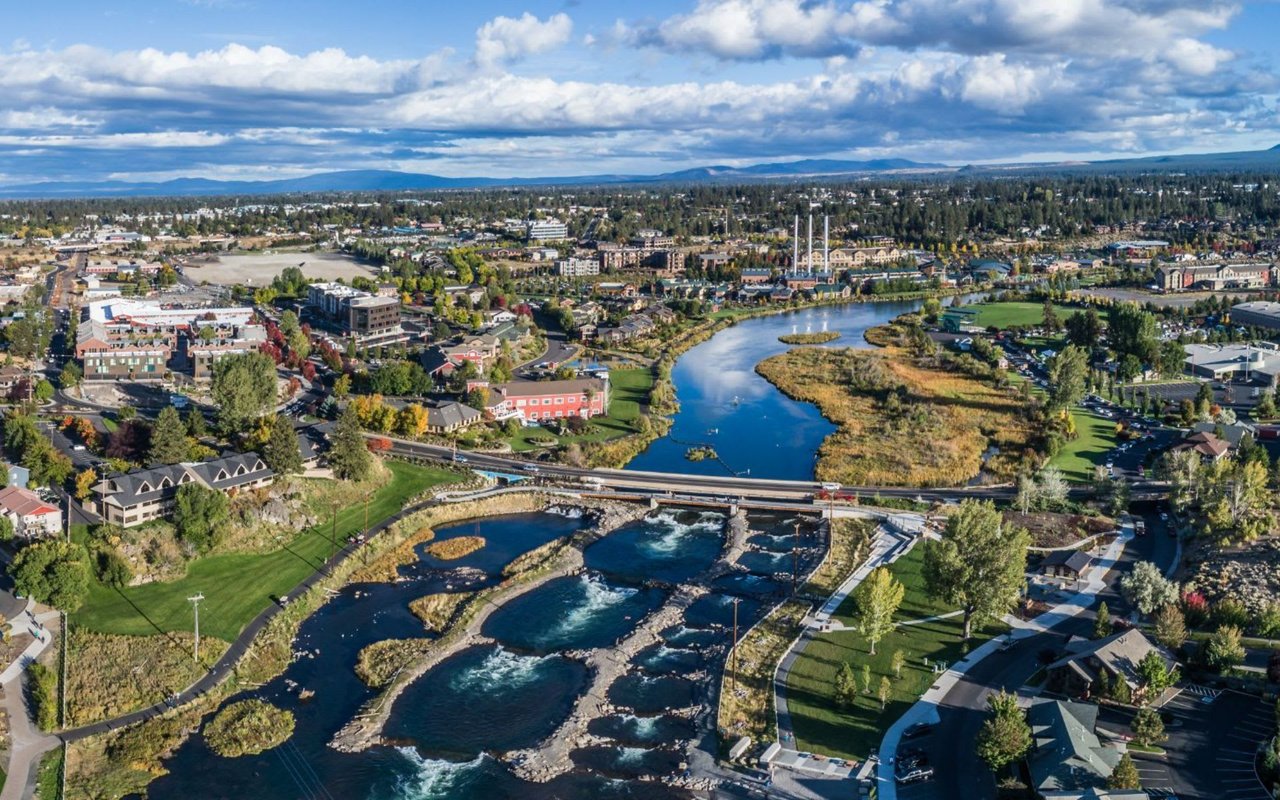
Stand on a footbridge in Bend’s Old Mill District on a summer evening and the city’s appeal is easy to understand. Paddleboarders move along the Deschutes. People gather for dinner overlooking the water. Across the river, a concert crowd boogies beneath the open sky.
Above it all stand three smokestacks - a reminder that this riverfront once helped power a very different Bend.
For much of the 20th century, lumber shaped the town’s economy, neighborhoods, and daily routines. Its transformation into a destination for outdoor recreation and a place people actively choose to call home took decades.
A railroad made the timber boom possible. A ski mountain broadened the possibilities. Local businesses and an ambitious riverfront redevelopment helped turn those possibilities into the Bend people recognize today.
Before the Mills: Farewell Bend
Bend’s history begins long before its first sawmill. The Wana Łama, Wasq’u, and Northern Paiute peoples lived in and traveled through this region for thousands of years. Their relationship with these lands continues, despite the displacement that accompanied European American settlement.
The later settlement known as Farewell Bend grew near a bend in the Deschutes River. It initially served nearby ranching and agricultural operations, and a post office established in 1886 used the shorter name, Bend.
When the city incorporated in 1905, it was still a small community. The river, surrounding forests, and a connection to the outside world would soon change that.
A Railroad and Two Lumber Giants
The Oregon Trunk Railroad reached Bend in 1911. Suddenly, Central Oregon’s timber could reach distant markets more efficiently.
Five years later, two Minnesota companies opened major sawmills on opposite sides of the Deschutes: Shevlin-Hixon in March 1916 and Brooks-Scanlon in April.
Bend became a lumber town on a remarkable scale. According to the Oregon Historical Society, the mills together processed more than 500 million board feet of timber annually at their peak.
Workers and their families needed homes. Businesses opened to serve them. By 1920, Bend’s population had grown to more than 5,000, and the town’s commercial and residential footprint expanded.
That era remains visible in historic downtown buildings and older neighborhoods near the city center. Their streets and homes connect today’s Bend to the people who built a life around the mills.
The Deschutes looked different then, too. Logs filled the mill ponds, and industrial operations occupied riverfront land that would eventually become a place for public trails and recreation.
The Outdoor Lifestyle Was Already Taking Root
Bend’s recreation culture grew alongside the timber industry.
Scandinavian lumber workers brought a love of skiing to Central Oregon. The Skyliners club, founded in 1927, helped establish a local tradition of winter sports and mountain adventure.
A few decades later, Bill Healy helped take that tradition to a much larger stage.
A World War II veteran of the Army’s 10th Mountain Division, Healy moved to Bend to manage his family’s furniture store. Working with other local ski enthusiasts and investors, he helped launch the Bachelor Butte ski area in 1958.
Its beginnings were modest: a Poma lift, two rope tows, and a small base lodge. The mountain’s effect on Bend would be anything but modest.
Visitors could ski on the mountain, then return to town for lodging, meals, and an evening out. That relationship helped spread the benefits of skiing into Bend’s businesses and gave the community a growing winter visitor economy.
The place now known as Mt. Bachelor became a major part of Bend’s identity and a reason for people to discover Central Oregon beyond its timber industry.
The Timber Economy Reached a Turning Point
The mills’ decline unfolded over decades.
In 1950, dwindling timber supplies on its private lands led Shevlin-Hixon to sell to Brooks-Scanlon. Its mill subsequently closed. Brooks-Scanlon continued operating through later ownership changes, but the remaining major riverfront mill shut down in 1994.
The Oregon Historical Society traces that final closure to diminishing timber supplies and a long history of intensive harvesting, followed by increasing reliance on federal timber.
For people whose livelihoods depended on lumber, this was a difficult transition. Bend’s reinvention came with lost jobs and uncertainty, even as recreation and other businesses created new opportunities.
Some of the connections between the two economies were direct. Timber-industry capital helped fund Central Oregon resort development, including Brooks Resources’ work at Black Butte Ranch. People and resources from the lumber era were helping shape what came next.
The Old Mill District Reconnected Bend With Its River
If Mt. Bachelor helped expand Bend’s identity, the Old Mill District made its transformation visible.
In 1993, Bill Smith and an investment group purchased 270 acres encompassing the former mill sites along both sides of the Deschutes. The property carried decades of industrial use, requiring environmental cleanup, planning, and substantial investment.
The vision centered on bringing people back to the water.
The Old Mill District officially opened on June 23, 2001. Shops, restaurants, restored buildings, and riverfront paths gave residents and visitors new reasons to spend time along the Deschutes. Outdoor concerts added another gathering place across the river.
The powerhouse and three smokestacks remained, keeping the district’s history in view.
Land once devoted to lumber production became part of everyday life in Bend: a place for a morning walk, an afternoon paddle, dinner with friends, or a summer concert.
Beer, Local Businesses, and Reasons to Stay
Bend’s appeal also developed through the businesses and gathering places around its outdoor activities.
In 1988, Gary Fish opened Deschutes Brewery’s downtown brewpub. Beers named for local landmarks, including Black Butte Porter and Mirror Pond Pale Ale, gave the business a close connection to its surroundings.
The brewpub became part of a broader experience: spending time outside, then returning to town for food, conversation, and a sense of community.
That combination helps explain Bend’s pull. Recreation may introduce someone to the area, but the experience of being here gives them reasons to imagine a longer stay.
Over time, the question for many visitors became: Could this be home?
From a Vacation Destination to Everyday Life
Bend’s population grew from 76,639 in 2010 to 99,178 in 2020 - roughly 29% in a decade.
The attraction is understandable. The river runs through town. The Cascades sit nearby. Public lands offer access to activities that people elsewhere may reserve for an occasional vacation.
For someone considering a move or a second home, those opportunities can shape ordinary decisions: where to live, how to spend a weekend, and what to make room for during the week.
The practical details still matter. Neighborhood location, housing costs, work, and travel routines all affect how well Bend fits a person’s life. A great vacation offers a starting point for that decision; living here brings its own considerations.
Popularity Brings Challenges, Too
Bend’s growth has put housing affordability at the center of its next chapter. The City reports that about 46% of renters are cost-burdened, spending at least 30% of their income on housing.
Keeping Bend a place where people can build a life means considering the needs of the workers, families, businesses, and longtime residents who sustain the community.
It also means caring for the river, trails, and surrounding landscape that contribute so much to the city’s appeal.
Bend’s future depends on how thoughtfully it manages the qualities that helped it grow.
The Smokestacks Still Tell the Story
Bend’s transformation is a story of the same landscape taking on new roles.
The river that carried logs now carries paddleboarders. The forests that supplied lumber also draw hikers, cyclists, and campers. A nearby volcano became a ski destination that helped broaden the local economy.
The three smokestacks preserve a visible connection between those chapters.
Next time you walk through the Old Mill District, look up. They are a reminder of the work that built Bend and the imagination it took to give the town a different future.
Thinking about making Bend part of your next chapter? Book a Call with Angie to explore neighborhoods, second homes, and the details that matter when choosing a Central Oregon property.