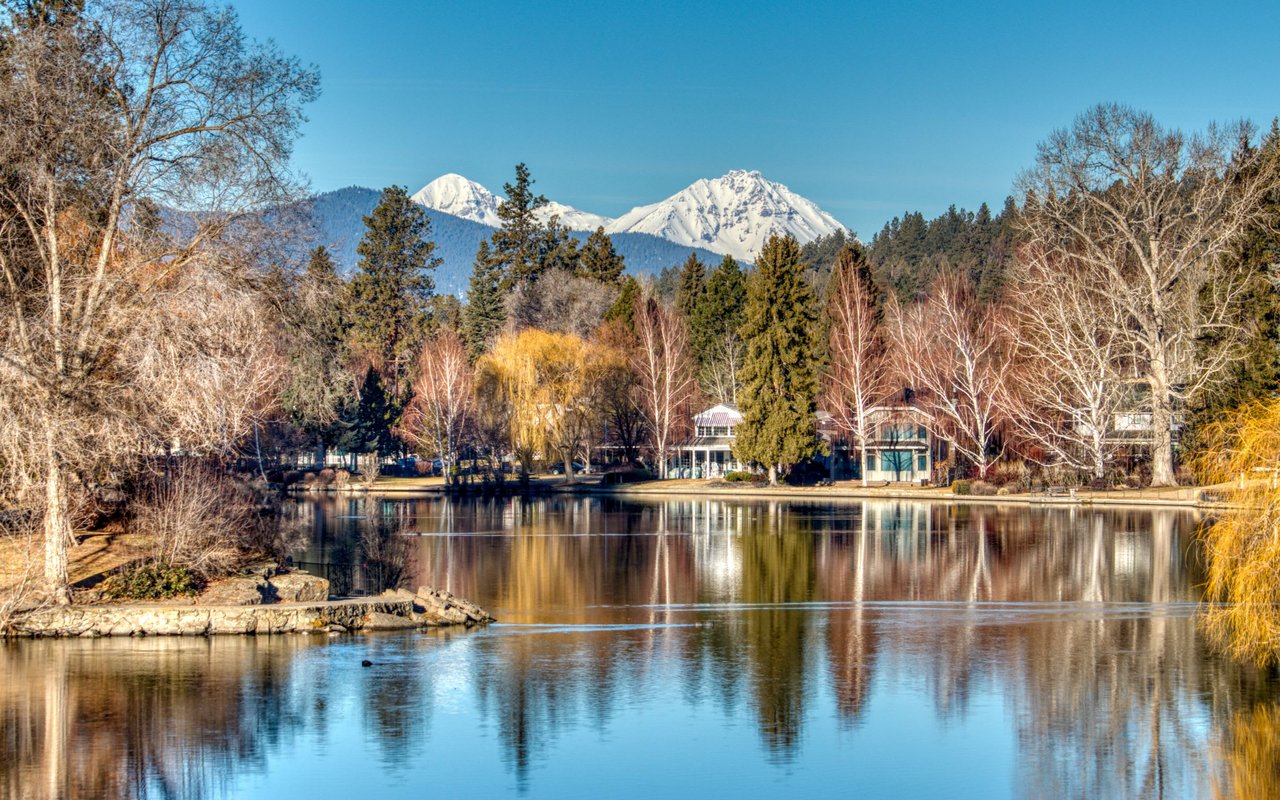
Is Bend, Oregon a Good Place to Live?
Oct 22, 2026 · @Angie Cox
Yes, for the right person. Bend is a city of about 107,000 people on the Deschutes River, with Mt. Bachelor about 22 miles away, a dry high-desert climate, and home prices well above the Oregon average. It rewards people who want the outdoors in their weekly routine and can absorb high housing costs, winter driving, and the occasional smoky summer week.
This guide covers what daily life actually looks like: the numbers on housing, weather, jobs, and growth, plus the tradeoffs locals talk about and visitors rarely see.
Bend at a glance
Population (city) | About 107,000 (2025 estimate) |
Elevation | 3,623 feet |
Annual precipitation | About 11 inches |
Annual snowfall in town | 3 to 81+ inches over the last 10 winters |
Median single-family sale price | $766,250 (YTD Sept. 2026, Cascades East REALTORS) |
Nearest commercial airport | Redmond (RDM), about 16 miles north |
The outdoors is a daily habit, not a vacation
Bend's biggest draw is how close the outdoors sits to ordinary life. The Bend Park and Recreation District runs 86 parks and natural areas and about 90 miles of trail inside the district, and the Deschutes National Forest starts at the city's southwest edge.
What that looks like in practice:
- Before work: a run on the Deschutes River Trail, or a lap at the Bend Whitewater Park downtown.
- After work: mountain biking on the Phil's Trail network on the west side, often 10 to 15 minutes from a west-side driveway.
- Winter weekends: Mt. Bachelor, about 22 miles west, with more than 4,300 lift-served acres and a season that usually runs from late November into May. Nordic trails at Virginia Meissner Sno-Park are closer still.
- Summer weekends: floating the river through town, paddling the Cascade Lakes, or climbing at Smith Rock, about 40 minutes north.
You don't need to be a hardcore athlete to enjoy it. Plenty of residents never ski. They walk the dog along the river, garden, catch a summer concert at the Hayden Homes Amphitheater, or meet friends at one of the city's many breweries.
Buyer tip: list the three activities you'd do most often, then time the drive to each from any home you're considering. Ten minutes of distance changes how often you actually go.
Weather: dry, sunny summers and real winters
Bend sits at 3,623 feet in the high desert, so it gets about 11 inches of precipitation a year, roughly a quarter of what Portland gets. Summers are warm and dry with cool nights. Winters are cold, but recent ones have swung wildly, from deep-snow years to nearly snowless ones.
What recent years look like:
- Snow is far less predictable. Over the last 10 winters (2016–17 through 2025–26), a west-side Bend gauge recorded anywhere from about 3 inches to at least 81 inches, roughly 35 inches in a typical winter. A gauge on the drier northeast edge of town usually recorded 15 to 25 inches.
- Last winter was nearly snowless. Bend gauges reported only 3 to 5 inches in 2025–26, and the April 1 Cascade snowpack near Mt. Bachelor was just 1% to 14% of normal.
- Late summers are hotter. Three of Bend's four warmest Septembers on record came in 2020, 2024, and 2025, and 2015 and 2021 rank among the city's five warmest years.
That 35-degree swing between day and night is the detail newcomers notice first. Frost can show up in June, so gardeners plan around a short growing season.
Winter living. Snow in town is usually manageable, but ice is the bigger issue. A north-facing, sloped driveway can stay icy for weeks. Look at sun exposure, garage space, and whether the street is on a priority plow route.
Wildfire smoke. This is the honest tradeoff of a Bend summer. Oregon DEQ counted 101 days of air rated unhealthy for sensitive groups or worse in Bend from 2013 to 2025, compared with six days from 2000 to 2012. Some years are mild (2025 was), and others bring weeks of haze from fires hundreds of miles away. Buyers should look for central air, a forced-air system that can take a MERV-13 filter, and a home that seals well.
What it costs to live in Bend
Housing is the biggest cost, and it is high. The median single-family home in Bend sold for $766,250 from January through September 2026, down 1.1% from the same period in 2025, according to the Cascades East Association of REALTORS. Zillow puts the typical Bend home value at about $729,000, compared with roughly $496,000 for Oregon and $369,000 nationally.
Prices have flattened after the frenzy years, but demand is steady. Bend closed 1,696 single-family sales through September, up 2.4% from 2025. The median home sold in 21 days, down from 29, and sellers received a median 98.6% of list price. Well-priced homes move quickly; overpriced ones sit.
Cost | Bend snapshot |
|---|---|
Median single-family sale price | $766,250 (Jan.–Sept. 2026) |
Median price per square foot | $400 (Jan.–Sept. 2026) |
Median days on market | 21 (Jan.–Sept. 2026) |
Average rent, all home types | About $2,600/month (Trulia, Sept. 2026) |
Average apartment rent | About $1,950/month (Trulia, Sept. 2026) |
Median household income | About $101,000 |
Sales tax | None in Oregon |
Oregon has no sales tax, which helps on big purchases, but it does have a state income tax. Property taxes depend on each home's assessed value, which in Oregon can differ a lot from market value, so two similar houses on the same street can carry very different tax bills.
Build a full ownership budget before you shop:
- Mortgage, property taxes, and homeowners insurance. Get an insurance quote early; wildfire risk is affecting premiums and availability in parts of Central Oregon.
- Utilities, including winter heating.
- HOA dues, which are common in west-side and resort communities.
- Snow removal, irrigation, and landscaping.
- Repairs or updates the home needs now.
Jobs, schools, and healthcare
Jobs. Bend's economy leans on healthcare, education, construction, tourism, and a long list of small businesses. St. Charles Health System is the region's largest employer, with more than 5,000 workers. Other major employers include Bend-La Pine Schools, the City of Bend, Central Oregon Community College, Les Schwab's headquarters, and manufacturers such as BasX, Epic Aircraft, and Lonza.
The local job market is smaller than a big city's, and pay doesn't always keep pace with housing costs. Many newcomers bring their job with them. If you're moving for remote work, confirm internet service at the exact address, since speeds vary on rural lots outside town.
Schools. Bend-La Pine Schools serves about 17,000 students across Bend, La Pine, and Sunriver, and runs several choice and magnet programs. Attendance boundaries matter, so confirm the assigned schools for any address directly with the district. For higher education, OSU-Cascades enrolled about 1,400 students in fall 2025 and is expanding, and Central Oregon Community College has its main campus at the base of Awbrey Butte.
Healthcare. St. Charles Bend is the region's main hospital and its Level II trauma center, so most specialty care is available locally. Some specialists do have waitlists, and new residents should start looking for a primary care provider early.
Where to live in Bend
The old shorthand is "west side costs more, east side gives you more house." It's roughly true, but walkability, snow, lot size, and commute vary block by block. Start with your daily routine and work outward.
Area | What it's like | Walk Score |
|---|---|---|
Old Bend / Downtown | Historic homes near Drake Park and Mirror Pond; walk to restaurants and the river | 82 |
River West | Older homes and newer infill near downtown and the Old Mill; strong trail access | 65 |
NorthWest Crossing | Planned west-side neighborhood with shops, schools, and a farmers market; premium pricing | Not rated by the city |
Awbrey Butte | Larger homes, views, and quiet streets; you'll drive for most errands | 10 |
Orchard District | Central, older, more affordable; close to Pilot Butte | 46 |
Larkspur / Southeast Bend | Newer construction, bigger garages, more value per square foot; Larkspur Trail nearby | 39 / 9 |
Walk Scores from a City of Bend neighborhood summary. Higher is more walkable.
A few things to check at any address: the drive to work and to the trailhead you'll actually use, traffic noise from Highway 97 or 3rd Street, nearby construction, and HOA rules. The west side generally gets more snow than the east side.
Nearby Central Oregon towns
If Bend's prices or pace don't fit, the surrounding towns offer a different mix. Typical home values from the Zillow Home Value Index, August 2026 unless noted (Bend is about $729,000):
Town | Distance from Bend | Typical home value | Best for |
|---|---|---|---|
Redmond | About 20 minutes north | About $511,000 | Value, airport access, a more practical feel |
Sisters | About 30 minutes northwest | About $783,000 | Small-town charm, mountain views |
Sunriver | About 20 minutes south | Varies widely by resort area | Resort living, second homes, bike paths |
La Pine | About 40 minutes south | About $410,000 (May 2026) | Lower prices, larger lots, quieter rural life |
Prineville | About 45 minutes northeast | About $430,000 | Lower prices, ranch country |
The tradeoffs locals will tell you about
Growth and traffic. The Bend metro area grew about 7% from 2020 to 2025, the fastest rate of any metro in Oregon, and the city added roughly 1,500 people in the most recent year. Roads haven't fully caught up. Expect slowdowns on the Bend Parkway (Highway 97), 3rd Street, and Reed Market Road at rush hour, plus plenty of roundabouts. Projects like the Hawthorne Crossing, a new walking and biking bridge over the Parkway, aim to reconnect the east and west sides.
Getting around. Most households need a car, and many need one with all-wheel drive or good winter tires. Walking and biking work well near downtown and along trail corridors, less so on the edges of town. Cascades East Transit runs local buses, but routes are limited.
Air travel and big-city access. Redmond Municipal Airport (RDM) is about 20 minutes north, with nonstop flights on Alaska, American, Breeze, Delta, and United to cities including Seattle, Portland, San Francisco, Los Angeles, Denver, Salt Lake City, Phoenix, and Las Vegas. Most other trips need a connection. Portland is about a 3½-hour drive over the Cascades, and mountain passes can be slow or closed in winter storms.
Tourist seasons. Bend is a hometown and a vacation destination at once. Summer weekends, holidays, and big concerts mean busier trailheads, river floats, restaurants, and parking. Locals adapt by going early, going midweek, and knowing the less-famous trails.
Wildfire risk at home. Beyond smoke, much of Bend sits in or near forest and juniper land. Ask about defensible space, roofing and siding materials, and insurance before you fall in love with a wooded lot.
Seasonal upkeep. Snow removal, sprinkler blowouts in fall, and dry-climate landscaping are part of owning here. Homes outside city limits may also have wells, septic systems, and private road agreements that deserve a close look.
Buying a second home or vacation rental in Bend
Bend works well as a second home, especially for buyers who plan to move full-time later. Plan for who will check on the house, clear snow, and handle a frozen pipe while you're away.
If rental income is part of the plan, know that Bend regulates short-term rentals (stays under 30 days) closely. Inside city limits:
- Every short-term rental needs a land use permit and an annual operating license from the City of Bend.
- Whole-house rentals in residential zones generally need 500 feet of separation from any other permitted whole-house rental. In many neighborhoods, that rules out new permits entirely.
- Permits don't transfer with the sale for most rentals approved after April 2015. A buyer has to apply fresh, under today's rules.
- Lighter options exist: "infrequent" whole-house rentals (fewer than 30 days and no more than four stays a year) and owner-occupied rentals of up to two bedrooms aren't subject to the 500-foot rule.
- A few resort areas are exempt from the land use permit, including Mt. Bachelor Village, Deschutes Landing, and parts of the Courtyards at Broken Top.
- Room tax of 10.4% applies to most short-term rental revenue.
HOA rules can be stricter than the city's, and homes outside city limits fall under Deschutes County rules instead. Check the city's eligibility map, read the CC&Rs, and never assume rental income will cover the mortgage.
Frequently asked questions
Is Bend, Oregon, expensive to live in?
Yes, mainly because of housing. The median single-family home in Bend sold for $766,250 in 2026 through September, well above Oregon's typical home value of about $496,000. Everyday costs are closer to normal, and Oregon has no sales tax.
How bad are Bend winters?
Colder than most visitors expect, but drier than the rest of Oregon. Snow varies a lot: recent winters ranged from a few inches to more than 80 on the west side, and January highs usually sit in the low 40s. Ice and freezing nights are the bigger adjustment.
Is Bend a good place to retire?
For active retirees, often yes: plenty of trails, golf, a senior center, and a regional hospital in town. Weigh the housing costs, winter driving, and distance to major airports and specialists.
Is Bend a good place for families?
Many families choose Bend for the parks, trails, and outdoor-focused schools. Confirm assigned schools for each address with Bend-La Pine Schools, and test the drive to schools and activities.
Can I buy a home in Bend and rent it out short term?
Possibly, but don't count on it. Most whole-house rentals in residential zones need a permit that is hard to get under the 500-foot spacing rule, and existing permits usually don't transfer to a buyer.
Should I look at Redmond or Sisters instead?
If budget is the priority, Redmond's typical home value is about $218,000 lower than Bend's. Sisters costs a little more than Bend, and Sunriver prices vary widely, but both offer a smaller-town or resort feel.
Thinking about making Bend home?
The best way to know if Bend fits is to test it: visit in January and in August, drive your future commute, and walk the neighborhoods you're considering.
Angie Cox helps buyers compare Bend and Central Oregon communities, evaluate properties, and sort through the local details before they buy. For out-of-area buyers, that includes virtual tours, honest observations about each home, inspection coordination, and introductions to local lenders, inspectors, and property managers.
Whether you're planning a full-time move or a second home, call Angie Cox at 541-213-9950 or visit Book a quick call with Angie to talk through what you're looking for.